

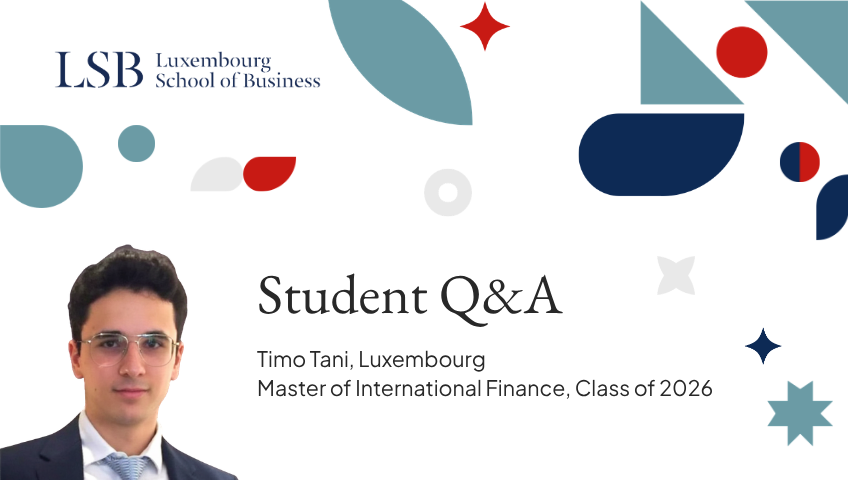
Timo Tani Shares About His Experience in the MIF
You did your bachelor’s in France and then looked at programs in several countries. What brought you to LSB?
“So, after doing my bachelor’s degree in France, which was close to Paris, I decided to have a look at the different programs. I’ve had a look at some business schools in France. I’ve had a look at some business schools in Germany. I found LSB not only through my research, but also at networking events — people talked about the business school. They convinced me to have a talk with the admissions team. I had a look at the program in detail and I particularly appreciated how practical the courses are.”
What do you mean when you say ‘practical’? What does that look like day to day?
“I would divide this into three different parts.”
“First of all, the courses are very practical. For example, in Valuation we had a group project where we had to estimate the fair value of a company. We were divided into small groups and we had to do our research, estimate the company’s fair value and present it in front of the other students and also the professor.”
“The second thing: within these two years, we did a lot of company visits. We visited UBS, the Luxembourg Central Bank, the Luxembourg Stock Exchange. These helped me to connect more with the real world, with the managers, with the HR people.”
“And the last thing: they organised a lot of CEO talks in school. They invited managers, CIOs, CEOs as well. They were talking about the expectations about Luxembourg’s financial hub in the next 20 years — and also what they expect from future students in terms of skills, professional knowledge, personal development.”
“I would say these three things sum up very well this practical argument of LSB.”
You also went on a study trip to China. How did that fit into the picture?
“LSB organised, for three to four weeks, a study trip with students having the opportunity to learn about the Chinese culture, but at the same time also having some finance classes. This gave me a broader perspective on global markets and helped me develop my adaptability in an international environment — and this is something a public university would never offer me.”
“I took part in this last summer and it was an amazing experience that I will never forget in my life. And I can also see now that LSB continues to do the study trips — they have one in Taiwan next summer, they have one in New York in June. For me, this is very essential for students that want to work in finance today, to have a broader perspective of the world.”
Now that you’re in your internship, can you point to specific skills you’ve taken directly from the program?
“I would definitely say my presentation skills and communication skills really improved within these two years at LSB. Most of the classes were set up in a way that we had to learn the theoretical concept and also the practical stuff — and in this practical stuff, we had to show our communication and presentation skills.”
“At my workplace, I had to do a market study about the life insurance industry in Luxembourg — on Excel and Word — and then present this in front of the managers and the CEO. Normal students who never do this kind of project or presentation would be very stressed. And I really noticed that I wasn’t nervous at all, because within these two years at LSB I’ve done so many group projects, so many presentations. It was just a habit. It was just something to get right back to what I learned in school.”
What stands out most when you look back at the two years overall?
“First of all, what I like is that we have these smaller classes, which makes the interaction very active between the students and the professors — which in most universities is non-existent. You just go to class, the professor doesn’t know your name, and you’re just considered a number. At LSB, with these smaller classes, they really try to have this personal interaction between the student and the professor. It’s a family environment, which makes a student comfortable — a better study environment, in my opinion.”
“The second point is the international environment. I was in a classroom with Chinese, Indian, Italian, Polish, Mexican, students from Chile, all in one classroom together. For example, I had really good talks with one of my good friends from Chile — a few years ago I had no idea about the economy in Chile, but now I have a broader perspective, a better understanding. This connection with the international environment is something LSB is doing really well.”
What’s next for you after graduation?
“I’m currently doing my internship at LALUX Assurances, and so far everything is going really smooth, really well — they are really happy with my performance. After my internship, I would like to stay there and build up my knowledge and my skills in the insurance sector for the next three to five years. And I’m very happy with all the tools and skills I learned within these two years at LSB. I can clearly see this at my workplace — where I can perform really, really well.”
Timo Tani is from Luxembourg and a current student in the Master in International Finance programme at Luxembourg School of Business. He was interviewed in April 2026.


