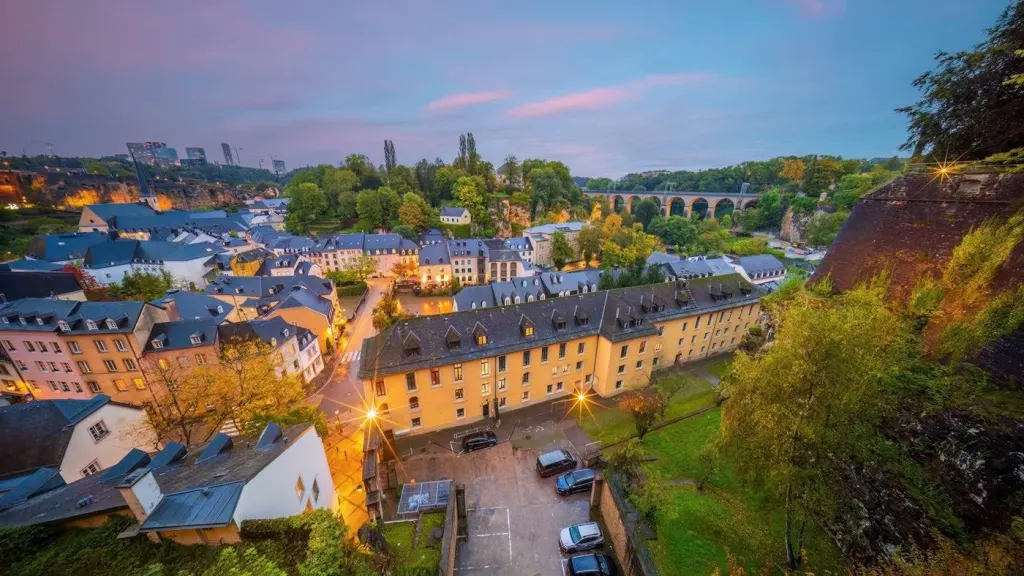
Climate and sustainable finance
Luxembourg hosts the first and largest green exchange. Sustainable finance is offered in both specialisation tracks.
Master program • 120 ECTS
Build the financial prowess to read markets, manage risk and make critical decisions, inside Europe's largest fund centre.
Corporate Finance or Capital Markets? Build your year two
The program
A two-year, full-time master's in international finance, taught in English and accredited by the Luxembourg Ministry of Higher Education and Research.
You don't need a business bachelor's degree. You can join the Business Bootcamp in maths and statistics to boost your readiness.
The six-month paid internship can take place in Luxembourg or abroad and culminates with an internship report.
Choose Corporate Finance or Capital Markets. Select at least eight electives to suit your learning and career goals.
Develop your own research question, supervised by a thesis advisor and defended orally in front of the advisor and a discussant.
Organised study trips to leading financial centres, plus Erasmus and exchange options with 20 partner schools.
Why Luxembourg
Luxembourg is the largest fund centre in Europe and the second largest in the world. You'll study about leading organisations where your lecturers work, with opportunities to pursue internships there.
Luxembourg hosts the first and largest green exchange. Sustainable finance is offered in both specialisation tracks.
The world's largest multilateral financial institution is based in Luxembourg, alongside EU institutions and public sector finance.
LSB uses its industry and public-sector partnerships to bring practitioners into lecturing and students into the institutions.
Curriculum
Coursework runs across three semesters, split into six modules of 15 ECTS each. Select a module to see what it includes.
How one module runs
Macroeconomics, the principles of finance and how to read a set of accounts.
Valuing a company, reading capital markets and using data and AI in finance.
Advanced modelling, derivatives and investment banking, with ethics alongside.
Business law, sustainable finance and the research methods you need for the thesis.
You start building your own specialisation from ten electives.
You finish your selection: at least eight electives, 30 ECTS across modules 5 and 6.
A foreign language runs through modules 1 to 4. The optional one-month Employability Module prepares you for the internship and can be taken together with Master in Management students.
Year one is 60 ECTS across four modules, plus a 6 ECTS Business Bootcamp where required.

Brochure
Two years, 120 ECTS and a six-month paid internship in Europe’s largest fund centre: the whole program in one brochure, to read at your pace.
Build your year two
In modules 5 and 6 you must choose at least eight electives, worth 30 ECTS in total. Your choices decide your specialisation in Corporate Finance or Capital Markets.
Ten electives are offered and you choose at least eight. Track leaning is our reading of the elective mix, to discuss with the program team.
Careers
The Career Centre has active relationships with major players in Luxembourg's financial centre, and guides you from your first CV to your paid internship.
Corporate, private and investment banking, in a centre with more than 120 banks.
Fund administration, asset and portfolio management in Europe's largest fund centre.
Transaction work, valuation and restructuring, on the Corporate Finance track.
EU institutions and public finance, in Luxembourg and abroad.
All MiF students are eligible for a work permit and residency in Luxembourg after graduation.
See guichet.lu for the conditionsThe MiF is a full master's with a mandatory thesis and paid internship, so you can continue your doctoral studies in Luxembourg or abroad.
Including the joint KU Leuven–LSB PhD“As a woman building a career in finance, the MiF program has given me the technical knowledge, confidence, and international exposure needed to stand out in a competitive field. Studying in Luxembourg — one of Europe's leading financial hubs — means learning in a truly international environment, surrounded by major institutions and industry professionals. The exceptional faculty, rigorous curriculum, and strong industry connections, including internships with leading firms, make this the ideal place to grow personally and professionally.”

“The MiF at Luxembourg School of Business offers a strong and supportive learning environment, with professors who combine academic expertise with real industry experience, making classes both rigorous and engaging. The school provides valuable networking opportunities essential for building connections early in your career. What sets the program apart is the exceptional support from the coordinator and academic director — always flexible, approachable, and ready to help — making it a great choice for students looking to grow both academically and professionally.”


Associate Professor of Finance
Luxembourg School of Business
Dr. Giulia Negri is a Fellow of the Corporate Finance and Real Estate Department a Business Developer of Central Europe at SDA Bocconi School of Management and a Fellow at BAFFI Carefin (a Finance Research Unit) at Bocconi University. She is an Associate Professor of Finance at the Luxembourg School of Business.
She has been working on national and international research projects, among others, with JP Morgan Private Banking, PwC, Parmalat, Assiteca, IBM, and Prysmian. She has also worked with industrial and business representation associations.
She is a member of the Executive MBA Faculty at SDA Bocconi where she teaches Corporate Finance and where she has been coordinating the Finance Week from 2018 through 2020. She is also engaged in tailor-made Executive Education. Taught classes at the Executive Level in Egypt and in Saudi Arabia.
Her field of interest, teaching, and research concerns business valuation, M&A as well as Cross-Border M&A, private equity, and venture capital.
She has been the Project Manager for “Bocconi Start-up Day” financed by Citi Foundation New York: an event dedicated to Italian start-ups and entrepreneurial projects creating a marketplace among investors and startuppers.
She has conducted several consulting projects for small and medium-sized companies with Madison Corporate Finance, an independent financial advisory firm specializing in Corporate Finance and M&A advisory.
She graduated summa cum laude at Bocconi University and she earned her PhD from the University of St. Gallen.

Associate Professor of Finance | Director of Strategic Projects
Luxembourg School of Business
Andrej Bajić graduated at Frankfurt School of Finance and Management from Master of Finance program with concentration in capital markets. At Zagreb School of Economics and Management he completed graduate program in quantitative finance. During his undergraduate studies he spent two semesters on student exchange programs, one in Taiwan at National Tsing Hua University, and another at European Business School in Germany.
Andrej is employed in Frankfurt as senior financial specialist in Deloitte Germany and works as external consultant at Deutsche Bundesbank. He leads the Deloitte team that works on evaluation of internal and external client portfolios with focus on debt and equity instruments and financial derivatives.
His previous work includes companies like KPMG, AVS-Valuation, SCDM Germany, Frankfurt School of Finance and Management, Platinum Invest and Croatian National Bank. On Zagreb School of Economics and Management he lectures Financial Institutions and Markets on undergraduate and graduate program and Financial Mathematics on graduate program.

Lecturer
Luxembourg School of Business
Ezechiel Havrenne is an investor and investment professional focused on private equity assets in the luxury segment and private debt with a FinTech component. He is the editor-in-chief of the Investment Management Review published by Larcier-Francis Lefebvre, and co-editor-in-chief of the European Investment Fund Review, the two leading investment fund reviews in the market. Ezechiel has a wide network of investment professionals working for large private equity and private debt firms, family offices, pension funds, funds of funds, insurance companies, and credit institutions. He received his LLM degree from the University of Pennsylvania-Carey Law School and a law degree with honors from the University of Louvain (Belgium). He teaches the Investment Funds chapter in the Financial Industry Management Program.

Lecturer
Luxembourg School of Business
Amir Younes is the North America Customer Success and Professional Services leader at Wrike, Inc. (a workflow management SaaS solution) in San Jose, CA, and an Adjunct Lecturer at the University of Michigan, Ross School of Business. Amir has worked in, led and built organizations across the globe including the US, Egypt, Peru and Chile and speaks several languages including English, Arabic, and Spanish.
Amir has nearly 20 years of global experience in leadership, technology, government, retail, healthcare, financial services and consulting. Prior to joining Wrike, he was a senior leader at both Rocket Fuel and Medallia and a strategy consultant at PricewaterhouseCoopers and Booz Allen Hamilton.
Amir actively coaches and leads training workshops for global public and private institutions; notable organizations include Qualcomm, Hewlett Packard (HP), the American Consulate in Alexandria, Egypt, Schutz American School, Booz Allen Hamilton, the University of Michigan, and Universidad Peruana de Ciencias Aplicadas (UPC).
Amir earned his B.S. in Computer Science and Management Science from the University of California, San Diego and an MBA with honors from the University of Michigan, Ross School of Business. Amir is also a Certified Myers-Briggs Practitioner focusing on leadership enablement.
Tuition & financing
One fee for the full two years. The non-EU fee includes the application to the Ministry of Immigration and related administrative costs.
The final semester consists of a mandatory paid internship, so you earn a salary during the last six months of the program.
Social, family, base and mobility scholarships and student loans are only available for Luxembourg citizens, residents and students whose parents work in Luxembourg. Apply at mengstudien.lu.
The mandatory internship is paid. You collaborate with the Career Center to secure an internship.
Awarded to those with outstanding academic achievement. Scholarship amounts range from 5% to 30%, but no fully funded scholarships are offered.
Admissions
One intake per year in September. Non-EU passport holders must apply earlier because they require extra time to complete student visa formalities.
Start typing your nationality.
Based on the country lists published by LSB. Admissions confirms your category.
Complete a short pre-application.
Takes a few minutesSubmit your documents and the €130 fee. After application screening, pre-selected candidates are invited to an admissions interview.
Admissions interviewAdmissions decisions are made on a rolling basis. Expect an answer within 2-5 working days after your application or interview (where applicable).
Then the visa process startsAccepting your offer requires a non-refundable €5,000 deposit, which is deducted from your first-year tuition.
LSB may ask for official recognition of your degree by the Ministry of Higher Education (€75, non-refundable).
| Intake | Fast track, all | Non-EU | EU / EEA / Swiss |
|---|---|---|---|
| September 2027 | 15 Apr 2027 | 15 Jul 2027 | 15 Aug 2027 |
Fast track gives you priority evaluation and a better chance of securing a seat.
Our admissions managers may send you more information about the program.
Yes. The MiF is open to bachelor’s degrees from all backgrounds. If your degree wasn’t quantitative, you can attend the Business Bootcamp courses in maths and statistics before the program starts.
Yes. LSB accepts TOEFL, IELTS, TOEIC or a Cambridge English test at B2 level or higher.
Pre-selected candidates are invited to an online interview about your documents, your background and why you want to join the program.
On accepting your admission letter you sign the study agreement and pay a non-refundable €5,000 deposit, which is deducted from your first-year tuition.
Coursework runs in six modules. Each module has two to three weeks of face-to-face teaching, midterm exams, another two to three weeks of teaching, then a study period and final exams.
In the third semester you choose at least eight electives out of ten, worth 30 ECTS. Corporate Finance covers strategic financial management, M&A and restructuring; Capital Markets covers equity and debt markets, derivatives and investment strategies. Build your selection.
The six-month internship is mandatory and paid, in Luxembourg or abroad, and ends with an internship report. The Career Centre helps you find and secure it.
A research question you choose, approved and supervised by a thesis advisor, written in English and defended orally in front of your advisor and a discussant.
Yes. All students are eligible for a work permit and residency after their studies. The conditions are on guichet.lu.
Yes. The MiF is a full two-year master’s with a mandatory thesis and internship, so you can continue to doctoral studies in Luxembourg or abroad.
Banking, funds, M&A and the public sector, in Luxembourg and abroad.
Take the first step
Applications for 2027 are open. Leave your name and email, then continue straight to the Master in International Finance application form, where you complete your details and upload your documents.
Questions along the way? Call or write to us.
Leave your details first, then continue to the application.
Your details are with admissions. Have these ready:
Curriculum, electives, fees and deadlines in one document.
Your numbers, the payment schedule and how scholarships work.
It's in your inbox, with a link back to this page.
See you at the event. We've sent the details to your email.
Choose your program first, then continue to the application.