

Meet Carolina Nikaedo, LSB’s Wellbeing Officer
Meet Carolina Nikaedo, LSB’s Wellbeing Officer
LSB is pleased to introduce Carolina Nikaedo, our Wellbeing Officer. With a background in Psychology and Cognitive Neuroscience, Carolina’s role is to support students in a proactive, confidential, and compassionate way — helping them navigate academic pressure, personal challenges, and moments of uncertainty while building resilience, connection, and a stronger sense of belonging at LSB.
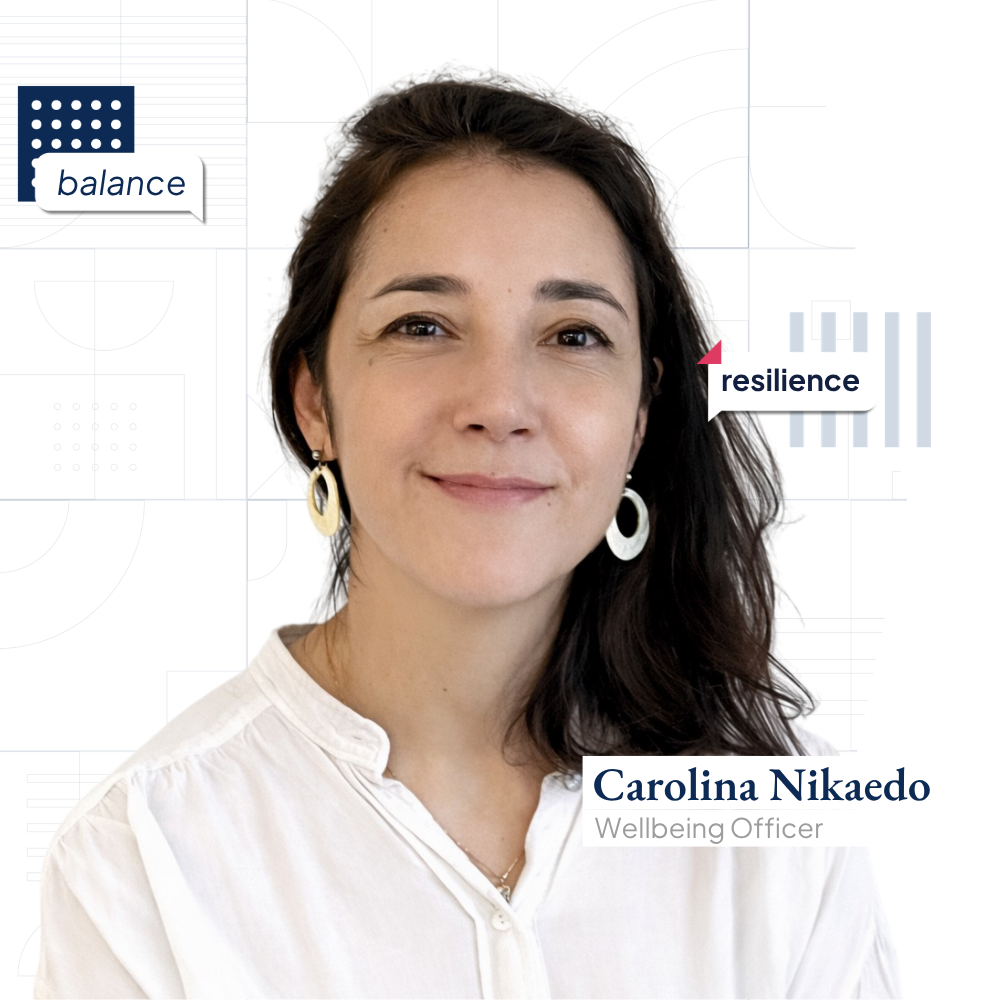
“Your presence matters, your voice matters, and your struggles matter.”
In this interview, Carolina shares her approach to student wellbeing, the support available at LSB, and why caring for mental health has become an essential skill for students, professionals, and future leaders.
Can you tell us a little about yourself and your role as Wellbeing Officer?
I’m Brazilian, a Luxembourgish citizen, and a proud mother of 2 lovely boys. We moved to Luxembourg in 2014 due to a work opportunity, and what was meant to be a three-year experience turned into something much longer. My professional background is in Psychology, with a PhD in Cognitive Neuroscience. Over the past 20 years, I’ve worked across various fields, including academia, clinical psychology, inclusion support in educational settings, and wellbeing consulting.
As a Wellbeing Officer, my role is primarily proactive: to promote wellbeing before difficulties become crises, and to step in with more direct support when needed. In other words, we will focus not only on fixing problems but on creating the conditions for people to feel seen, supported, and resilient in their daily lives.
This work is built around three pillars — knowing, doing, and engaging.
Knowing
Knowing is the first step toward meaningful change. Through workshops and group discussions, students will gain evidence-based information on how the brain and mind work.
Doing
Doing is about practice. Students will be introduced to scientifically grounded tools and everyday strategies to manage stress and strengthen emotional resilience.
Engaging
Engaging reflects the social aspect of wellbeing. Together with Pascal Wiscour-Conter and the Community Engagement team, the service will support connection, belonging, and community building.
What inspired you to work in student wellbeing?
As a psychologist, I’ve always been deeply interested in understanding why people with similar life conditions can experience such different outcomes in terms of their life satisfaction, happiness, and overall wellbeing. What fascinates me most is seeing how, with the right guidance and support, people can adjust their internal narrative and the lens through which they interpret the world. In doing so, their wellbeing barometer gradually increases. In many ways, these are teachable skills — skills anyone can learn and practice.
“With the right guidance and support, people can adjust their internal narrative.”
How can students benefit from the wellbeing service?
In a world saturated with information, it’s often difficult to know what is truly reliable, relevant, and helpful. Through the wellbeing service, students will have access to evidence-based knowledge and practical tools that can genuinely support them in navigating life’s academic and emotional challenges.
At the same time, science has shown that knowing something is not enough to create real change. Understanding must be paired with experience, practice, and connection. That’s why the wellbeing service will also include small group spaces, where students can meet others who may be facing similar challenges, share experiences, and feel less alone in what they’re going through. Individual support will also be available.
What are the most common challenges students come to you with?
As I’m just starting in this role, my perspective is based mainly on informal conversations I’ve had with students so far, especially BiB students, as I’m currently closer to them. Even from these early exchanges, some clear themes are already emerging.
Some students share difficulties in relationships, with peers, with professors, or within group work. Very often, the underlying challenges relate to communication, especially in an international environment where many students are not working in their mother tongue, and they come from different cultural backgrounds. This can make self-expression, conflict resolution, and boundary-setting much more complex.
Anxiety is another recurring theme, both in everyday situations, such as presentations, exams, and performance pressure, and in deeper, long-term concerns about the future and fear of what one’s place will be in a world shaped by AI and technological transformation.
How can students contact you or book a session?
Students can book individual sessions with me, usually lasting around 30 minutes. These meetings are designed as a safe, confidential space where they can openly share their concerns, thoughts, and questions.
The purpose of these conversations is to understand what the main challenge is and what kind of support would be most helpful. Each situation is different, and support is always tailored to the individual. When needed, I will also help coordinate referrals to other professionals or services, so students don’t have to navigate that process alone.
These sessions are different from a traditional clinical setting, in which a person attends weekly sessions over a long period of time. Instead, this is a guidance-based and problem-solving approach focused on helping students make sense of what they’re experiencing, identify next steps, and find the right form of support.
What message would you like to share with LSB students?
I’ve been deeply inspired by the science of mattering, a simple and powerful idea that speaks to a universal human need: the need to feel that we matter, that we are seen, valued, and respected for who we are, not just for what we achieve.
“Your presence matters, your voice matters, and your struggles matter.”
At LSB, we are committed to supporting your journey by providing top-notch knowledge and technical excellence, while also caring for you as a human being. We live in a complex and volatile world, full of uncertainty. For the first time in history, we’re witnessing an epidemic of mental health disorders and loneliness, alongside an accelerated pace of life and an enlargement in synthetic relationships.
Wellbeing is not just a trend. Learning how to care for our mental health and, consequently, being able to promote emotionally safe environments as leaders has become a fundamental skill in the labour market.


